Technical article
How Automatic Eggplant Stem Cutting Works
Automatic eggplant stem cutting is not only a cutting problem. It is a product-understanding problem followed by a controlled mechanical action.
Start With the Cut Your Process Needs
An automatic eggplant stem cutting machine removes the stem and calyx before another process such as slicing, freezing or canning. Topping and head cutting are names for the same preparation step. The acceptance criterion should describe the fruit that leaves the station: which green tissue must be removed, what cut face is acceptable and how much edible flesh may be lost.
A demonstration shows the operating sequence. It does not establish capacity or yield for a different variety, harvest or factory. DOKTEK confirms those requirements through application engineering with the processor’s samples.
Present the Product on a Moving Conveyor
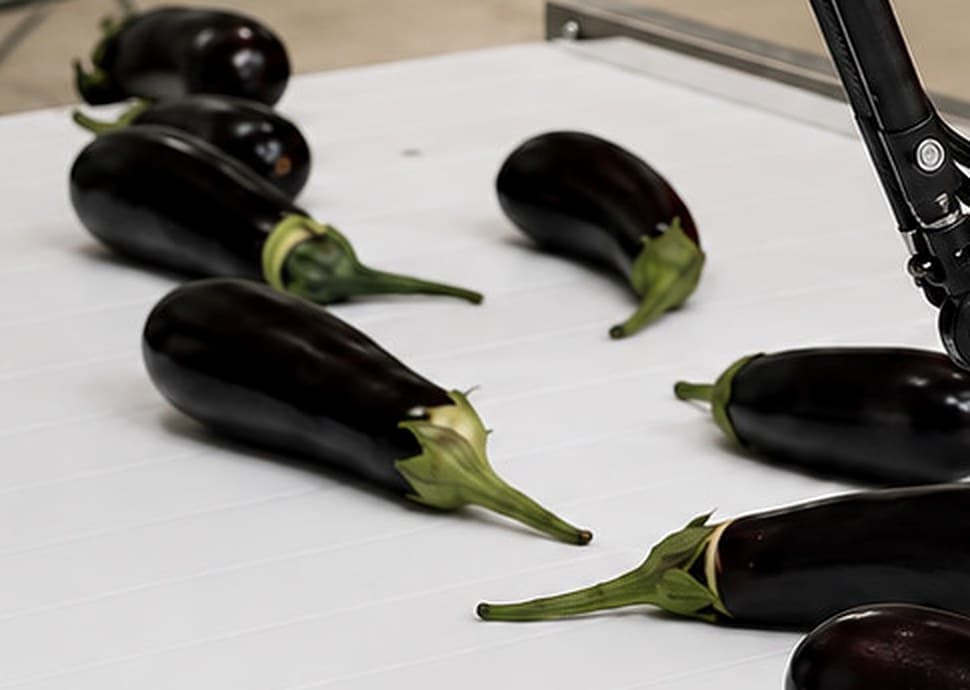
DOKTEK’s demonstration shows eggplants travelling on a conveyor in different orientations. The system locates each product instead of requiring an operator to align every stem with a fixed cutting position.
Infeed still matters. Overlapping products can obscure the stem, and inconsistent spacing can change the demands on the cutting station. During evaluation, include the product presentation expected after washing or upstream handling, rather than selecting only easy specimens.
Locate the Stem and Translate the Coordinates
The vision step identifies the eggplant, its orientation and the stem region. The control system translates the detected position from image coordinates into a cutting target in the machine’s coordinate system.
The product continues moving between detection and cutting. Conveyor movement and the timing of the robotic action therefore have to be considered together. A correct mark on a still image is only one part of proving a repeatable cut.
Check the Fruit and the Removed Cap
After the cut, inspect both outputs. A clean-looking fruit may still have lost unnecessary edible material with the cap. Conversely, a shallow cut may leave tissue that the downstream process cannot accept.
Agree a trial method that records accepted pieces, residual stem or calyx, damaged pieces, repeat cuts and edible material removed. Compare the same product mix with the current manual method. Define waste collection and transfer to the next process in the proposed layout.
Prepare a Representative Trial
Use samples that reflect the range you actually receive, including difficult pieces. Agree the acceptance rules before filming or timing the run, and retain the product description with the results.
- Product variety, dimensions, curvature and harvest condition.
- Photos of acceptable and unacceptable cut faces.
- Wetness, overlapping products and spacing at the intended infeed.
- Timed run duration, accepted output, stops and rework.
- Upstream and downstream conveyor heights and available space.
What the Demonstration Establishes
DOKTEK’s own footage demonstrates the conveyor, vision and robotic cutting sequence on eggplants. It is useful evidence of the mechanism. Published throughput, accuracy and payback figures require a defined configuration and measured results; none is inferred from the length of the video.
The main machine page contains the demonstration and integration information. Send your process details to discuss which trial conditions should be used for your line.
Next step
Evaluate the process on your product.
The correct automation decision depends on your product, line layout and target process.