Primary product
Production machineAutomatic Eggplant Stem Cutting Machine
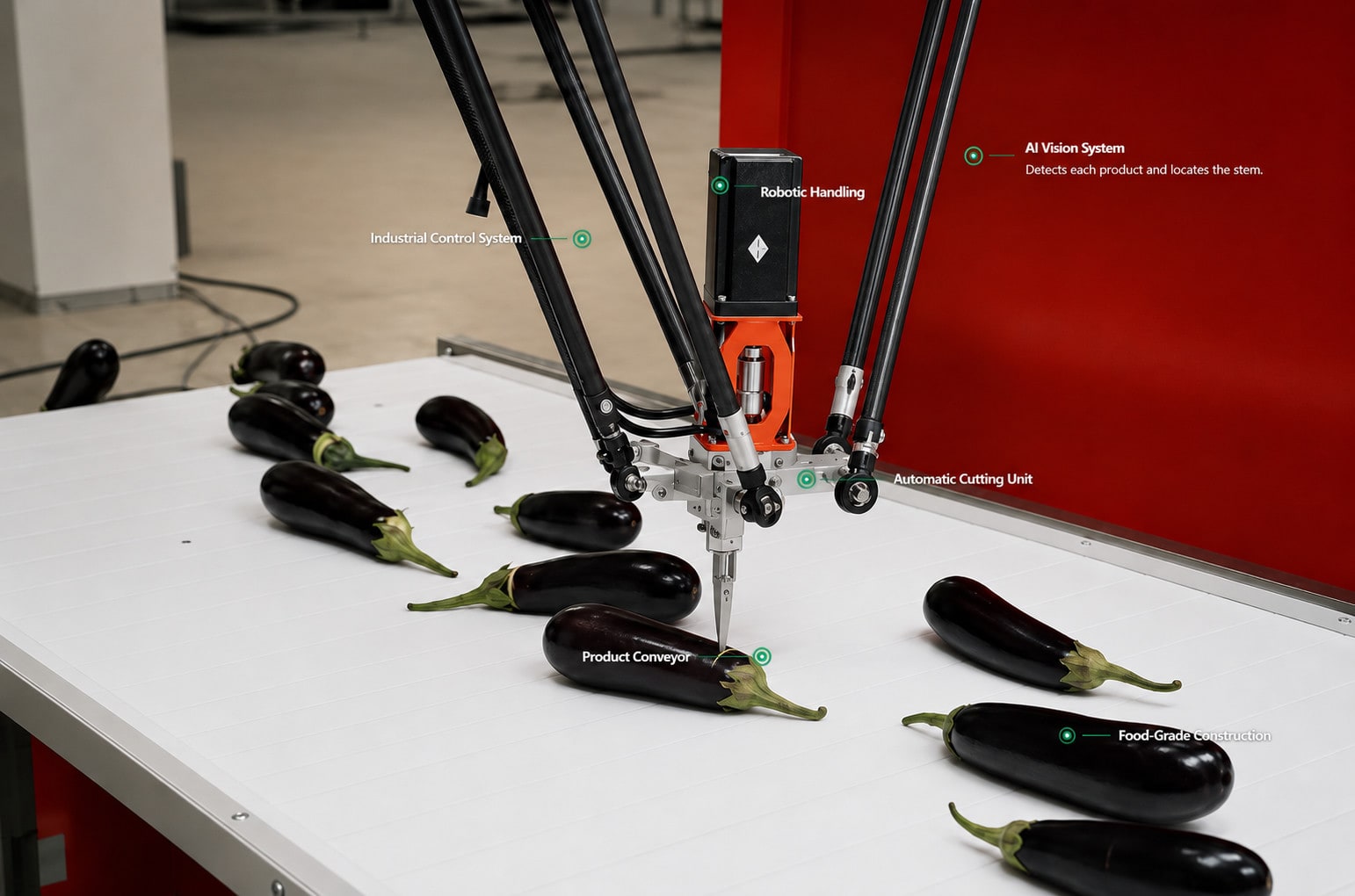
DOKTEK FoodTech develops an automatic eggplant stem cutting machine for processors that need consistent stem, calyx or top removal without aligning every product by hand.
Production machine demonstrated in DOKTEK’s own footage. Product range and performance are confirmed for your configuration.
Machine summary
- Application
- Industrial eggplant stem removal
- Detection
- Camera-based product and stem localization
- Cutting
- Vision-guided robotic positioning
- Terminology
- Stem cutting, calyx removal, topping and trimming
- Capacity
- Confirmed from trials on your product
- Construction
- Stainless steel machine construction
- Integration
- Configured around the production line
Machine operating video
See the vision-guided cutting process in motion.
The DOKTEK demonstration video shows continuous product infeed, machine vision detection and automatic stem cutting on real eggplants.
The manual step this machine replaces
Most processors still remove eggplant stems by hand: one operator, one knife, one fruit at a time. It works, but it is usually the step that limits the line.
Labour tied to one repetitive task
On a manual line, output rises only by adding people at the trimming table, and the work is repetitive enough to be hard to staff through a full season.
Cut depth varies with the operator
Each operator judges the cut by eye. Late in a shift some fruit keeps part of the calyx and some loses usable flesh, and neither is recorded.
No numbers to manage
Manual trimming produces no count of accepted, reworked or over-cut product, so yield loss and consistency remain estimates rather than measurements.
Every fruit handled at a knife
Each eggplant passes through an operator's hands at a knife station, which adds contact points and makes the step depend on individual discipline.
How the system works
Six steps, repeated for every fruit on a moving belt.
- 01
Conveyor infeed
- 02
Image capture
- 03
Stem & calyx keypoints
- 04
Cut-line calculation
- 05
Robotic cut on the move
- 06
Fruit and caps discharged
Product is processed on the move: the belt is not stopped to align or index each fruit.
Main modules
The machine is a set of modules arranged along the product flow. Exact dimensions, conveyor width and line interfaces are defined for each configuration.
- 01
Infeed conveyor
Carries eggplants through the machine continuously. Fruit arrives in random orientation and does not need to be placed in pockets or aligned by hand.
- 02
Vision station
An industrial camera images each fruit. A deep-learning model detects the product, locates keypoints at the calyx and stem, and calculates the cut line for that individual fruit.
- 03
Delta robot cutting unit
A parallel-kinematic delta robot carries the cutting tool to the calculated position and places the cut while the product continues along the belt.
- 04
Discharge and cap separation
Prepared fruit continues to the downstream line and removed caps are separated. Discharge direction and waste handling follow your layout.
- 05
Control system and HMI
Motion, vision and I/O run under one industrial controller, supervised from an operator HMI. Line signals such as start/stop, alarms and production counts are scoped per project.
- 06
Stainless steel frame
Stainless steel machine construction, with product-contact areas and service access considered in the configuration. Steel grade and cleaning method are confirmed for your plant.
The photographs and footage on this page show DOKTEK's production machine. Your configuration is drawn up after the evaluation described below.
Is this machine a fit for your process?
An honest first filter. Borderline cases are decided by a trial on your product, not by this list.
Suitable for
- Industrial processors removing eggplant stems and calyx before freezing, grilling, frying, pickling, canning or further cutting
- Lines where fruit arrives in random orientation and is aligned by hand today
- Operations where stem trimming ties up operators on every shift
- Plants that can present fruit in a single layer on a conveyor, or are planning such an infeed
- Processors who want the cut defined, measured and repeatable from shift to shift
Not suitable for
- Slicing or dicing whole fruit: DOKTEK's separate slicing and dicing line does that job
- Low volumes where a few hours of manual trimming a day remain the more economical option
- Bulk-dumped, stacked or badly damaged fruit that cannot be presented one piece at a time
- Buyers who need a guaranteed capacity figure before any trial on their own product
- Other vegetables without a feasibility review: okra runs on a separate pilot station, and every other product is tested first
What Is an Eggplant Stem Cutting Machine?
An eggplant stem cutting machine removes the stem or head section before downstream processing such as slicing, dicing, freezing, pickling, canning or packaging.
The challenge is that eggplants are natural products. Length, curvature, stem position and incoming orientation change from one product to the next. A useful industrial system has to locate the correct cutting position for each product, not simply apply one fixed blade position to the whole batch.
How the DOKTEK System Works
Products are carried through the machine on a conveyor. A camera-based inspection step detects the product, establishes its orientation and identifies the stem area before the cutting action is placed.
The calculated cut position is transferred into the machine motion system so the cutting assembly can remove the stem in a controlled, repeatable process.
- Automatic product detection on the conveyor
- Stem localization and cutting-position calculation
- Robotic positioning of the cutting action
- Configuration against the processor's product and line layout
Continuous Conveyor Workflow
The workflow starts with product entering the system on a moving conveyor rather than being placed one by one into a fixed pocket. That matters because the operator is no longer responsible for aligning every eggplant before the cut.
As each product passes the inspection area, the vision system determines the product position, orientation and stem or calyx region. The machine then converts those detected coordinates into a cutting target in the machine frame, so the cutting mechanism can act while the product continues through the process.
After cutting, the prepared fruit and removed cap or stem section have to leave the station cleanly. Discharge direction, waste handling and downstream transfer are defined during application engineering because they depend on the processor's line layout.
- Continuous infeed on a conveyor
- Vision detection before the cut is placed
- Cut coordinates calculated for each product
- Prepared product and removed caps discharged into the line layout
Machine Vision Detection
The machine uses camera-based vision to handle products that do not arrive in the same orientation. The system is designed to identify the product geometry and determine where the stem area sits before cutting.
No public accuracy percentage is published because performance depends on product condition, lighting, line speed and configuration. DOKTEK FoodTech evaluates those details during application engineering.
Stem, Calyx, Top and Trimming Terminology
Industrial buyers use several names for the same preparation step: eggplant stem cutting, eggplant stem removal, calyx removal, top cutting, topping and eggplant trimming. The exact wording often depends on the buyer's region or the way the process is written in an internal specification.
These names describe one vision-guided operation unless a project requires a different cut result. The useful engineering question is what must be removed, how much usable product may be taken with it, and what the downstream process expects from the cut face.
Robotic Cutting Process
After the vision system has calculated the cut, the machine positions the cutting action against that individual product. This is the difference between a vision-guided cutting machine and a conventional fixed-position trimming station.
The exact machine configuration, including infeed, discharge and control interfaces, is defined around the existing or planned production line.
Industrial Food Processing Applications
The machine is intended for food processors that prepare eggplant at industrial scale and want to reduce repetitive manual trimming while keeping the operation measurable and controllable.
Typical downstream contexts include frozen vegetables, canned products, pickled products, prepared vegetables and further cutting operations.
Hygienic Stainless Steel Construction
DOKTEK FoodTech presents the machine as stainless steel food-processing equipment with product-contact areas and service access considered during configuration.
Confirm the steel grade, cleaning method, protection rating and required documentation during application engineering so they match your factory’s hygiene procedures.
Production Line Integration
The machine is one process stage. Its value depends on how it receives product and where the processed product goes next.
DOKTEK FoodTech can discuss upstream feed, product presentation, discharge, alarms, operator supervision and digital I/O with the engineering team responsible for the line.
Advantages Compared With Manual Cutting
Manual stem cutting is flexible, but it is repetitive, labor-intensive and difficult to measure consistently across shifts. Automation makes the cutting process easier to supervise and standardize.
The business case should be calculated from the processor's own labor cost, product mix, target output and current yield loss. DOKTEK FoodTech does not publish a generic payback claim.
Define the Cut Face Before the Trial
An eggplant topping machine, head cutter and calyx removal machine can describe this same station. Specify the result on the fruit: whether any green collar may remain, how much edible flesh may be removed and what surface the next process requires.
Check the removed cap as well as the prepared fruit. Agree how residual stem, damaged pieces and cuts needing rework will be counted. The same criteria should be used for the manual baseline and the machine trial.
Vision-Guided Stem Cutter vs Fixed-Feed Stem Cutter
Two very different machines are sold under the name eggplant stem cutter. A conventional electromechanical cutter works from a fixed reference: an operator places each fruit into a feeder and a blade cuts at a set position. It is simple and inexpensive, and its consistency depends on the operator presenting every product the same way.
DOKTEK's machine takes the opposite approach. Eggplants travel on a conveyor, a camera locates each fruit and its calyx, and the cut is calculated per product before the robot places it. Orientation, length and curvature are handled by the detection step instead of by the operator's hands.
A fixed-feed cutter can be the right choice for a small canning line where an operator already stands at the station and product variation is low. The vision-guided machine is aimed at processors who want the operator off the station, run mixed sizes and varieties, and need cut placement to stay measurable across shifts.
- Fixed-feed: operator loads each product; blade at a set position
- Vision-guided: conveyor infeed; cut located by camera on each product
- Fixed-feed: consistency depends on presentation
- Vision-guided: consistency depends on detection, verified on your samples
What the Removal Leaves Behind, and Where the Caps Go
Cutting separates the stem from the fruit; removal is judged by what remains once the calyx and stem cap come away as one piece — the flat cut face, and whether a green collar is left around its edge. Two things decide whether that result is acceptable, and both belong to the processor: where the cut has to sit for the downstream process, and yield, because every millimetre taken above the calyx leaves as waste.
The waste stream has to be planned with the cut. Stem caps must leave the machine continuously and separated from the fruit, or the manual work that automation was meant to remove reappears further down the line. Discharge direction, drop height and how the caps meet an existing conveyor or bin are settled against your layout during the application review — they are a common reason an otherwise suitable machine is awkward to install.
Comparing Two Automatic Machines Fairly
Machines described as automatic differ in where the human stays in the loop. A semi-automatic cutter still needs someone to place or orient each product, so the operator sets the pace and the cut is only as repeatable as their attention late in a shift. Removing the blade from the operator's hand is not the same as removing the operator.
Capacity figures are not comparable unless the conditions behind them match. Four questions make two quotations comparable: what product size and condition range the figure was measured on; whether it assumes pre-oriented infeed or takes product as it arrives; what happens to a product outside the expected range — rejected, passed through uncut, or cut badly; and who integrates with the conveyors already installed. A lower machine price with integration left to the buyer is not cheaper once conveying, guarding and controls are priced in.
Feeding, not cutting, is usually the constraint. A machine dropped into a line that cannot present product singly and steadily will idle between fruit and never reach the rate it is capable of, which is why DOKTEK reviews the surrounding line before proposing a configuration.
Engineering evaluation process
How an enquiry becomes a quotation. Each step produces something you can check.
- Step 01
Product video and photos
You send a short video of the current manual process, photos across your size range and your target output. A Google Drive, WeTransfer, Dropbox or private YouTube link is enough.
- Step 02
Feasibility review
An engineer reviews the material and replies with the questions your configuration depends on: size range, stem condition, infeed, cut criteria, hygiene and line layout.
- Step 03
Cut criteria agreed
Before any trial we agree what a correct cut means on your fruit: how much green collar may remain, how much flesh may be removed and how rework is counted.
- Step 04
Product trial
Your samples are run on the machine and the results are recorded against the agreed criteria on DOKTEK's trial-record form.
- Step 05
Configuration and layout
From the trial results and your line drawing, DOKTEK proposes the configuration: conveyor dimensions, infeed, discharge and line interfaces.
- Step 06
Quotation
The quotation states the configuration, scope of supply, documentation, shipping and commissioning, and the capacity basis confirmed in the trial.
Before quotation
A quotation is only as reliable as what was confirmed before it. These points are settled first.
Final capacity depends on product size, stem orientation, feeding consistency, required cut quality and confirmed test results. DOKTEK does not quote a fixed capacity before these are known.
- Eggplant varieties and the size range the machine must cover
- Stem length, calyx condition and how fruit arrives: washed, graded, orientation
- Feeding consistency: single layer, spacing and the rhythm upstream equipment can deliver
- Required cut quality: acceptable residue, flesh loss and how rejects are counted
- Target capacity in kg/hour or pieces/hour, checked against trial results
- Line layout, conveyor heights, utilities and available floor space
- Cleaning procedure, hygiene requirements and documentation, including CE documentation scope
- Destination country, installation and commissioning requirements
Next step
What we need from your product
The more representative the material, the faster the feasibility answer. Difficult fruit tells an engineer more than perfect fruit.
- 01A 1–2 minute video of your current stem-cutting process
- 02Photos of typical, smallest, largest and most curved fruit
- 03Photos of an acceptable cut and of an unacceptable one
- 04Variety names and the seasonal variation you expect
- 05Current output, operators on the task and target kg/h or pcs/h
- 06How fruit reaches the station today, and what happens after cutting
- 07Physical samples for the trial, once the review reaches that step
- 08Destination country and the documentation you require
Download technical brief
Take the machine to your team
The CUT-E catalogue covers the cutting principle, the machine-vision detection, line integration, hygienic construction, the technical data sheet and the trial-record form we complete on your product.
PDF · 12 pages · 1.2 MB · EN
Every figure in it is either verified or marked as confirmed during project review.
Evidence and status
Status
An existing DOKTEK machine, shown in DOKTEK's own footage and photography.
Listed under: Cutting & trimming
Public evidence
DOKTEK demonstration video, machine photography and commissioning footage.
CUT-E
Footage of this machine
- Automatic eggplant stem cutting machine in operationProduction machine footage
- The machine running: belt, product and robotProduction machine footage
- The cutting unit descending to the productProduction machine footage
Frequently asked questions
Questions before a machine evaluation.
01What is an automatic eggplant stem cutting machine?
It is an industrial machine that detects each eggplant and removes the stem section automatically before downstream food processing.
02How does the machine detect the eggplant stem?
The DOKTEK system uses camera-based machine vision to identify product geometry and localize the stem area before the cutting process is placed.
03Can the machine process different eggplant sizes?
Yes. The vision system calculates the cut for each fruit instead of assuming one size. The size range a configuration covers is confirmed with your samples, including your smallest, largest and most curved fruit.
04Is capacity guaranteed before testing?
No. Capacity depends on product size, stem orientation, feeding consistency and the required cut quality. It is confirmed in a trial on your product and stated in the quotation on that basis, not promised in advance.
05Do you need product samples?
Not at the start. A process video and photos are enough for the feasibility review. Physical samples are needed for the product trial that comes before a final quotation.
06Can we send videos for evaluation?
Yes, and it is the best first step. Send a short video of your current process through the project review form as a Google Drive, WeTransfer, Dropbox or private YouTube link, or send it on WhatsApp.
07Does the machine use machine vision?
Yes. The process is based on machine vision and robotic positioning rather than a single fixed cutting position.
08Can it be integrated into an existing processing line?
Yes. Integration is scoped per project, including upstream feed, discharge, I/O, alarms and operator supervision.
09Is it suitable for industrial food production?
It is designed for industrial food-processing environments. Final construction details and hygiene requirements are confirmed for each configuration.
10Is this the same machine as an aubergine stem cutting machine?
Yes. Aubergine is the name used in the UK and many European markets, eggplant elsewhere; it is the same product and the same machine. European frozen, grilled, pickled and canned aubergine lines are evaluated the same way, from samples, a process video and the destination country.
11Is this also an eggplant trimming machine?
For buyers using trimming terminology, yes: the same DOKTEK system is used to trim the stem, top or calyx section. The exact cut result is confirmed from the processor's own product samples.
12Can the machine be customized for our factory layout?
Yes. Infeed, discharge direction, conveyor dimensions and line interfaces are configured around your layout and your upstream and downstream equipment, based on your line drawing and the trial results.
13Can DOKTEK prepare CE documentation?
CE documentation can be prepared according to the machine scope and the requirements of the destination market, and the documentation package is defined in the quotation. This page does not claim a certificate that has not been issued for your machine.
14Do you ship internationally?
Yes. DOKTEK designs and manufactures in Denizli, Türkiye, and builds machines for export. Packing, shipping terms, installation and commissioning support are agreed per project and destination.
15Can this system be adapted for other vegetables?
Yes — DOKTEK has built and is running an okra stem cutting station on the same vision and motion platform. For any other irregular vegetable, feasibility is confirmed from real samples before any claim is made.
16Is a stem cutter the same as a stem cutting machine?
Yes. "Eggplant stem cutter", "stem cutting machine", "stem removal machine", "topping machine" and "calyx removal machine" all describe equipment that removes the stem and calyx. The meaningful difference is fixed-feed versus vision-guided operation, not the name.
17How much does an automatic eggplant cutting machine cost?
No list price is published here. The machine is quoted per configuration — conveyor width, line integration, product range and target throughput — after DOKTEK has reviewed your fruit and your line. A published price that ignores those would not be a price you could plan a line around.
18What information is required for a quotation?
Product varieties and size range, a process video, photos of acceptable and unacceptable cuts, target capacity in kg/hour or pieces/hour, your line layout and utilities, hygiene and documentation requirements, and the destination country. A product trial confirms the capacity basis before the final quotation.
Flagship machine
Built for the factory floor.
Vision, motion, cutting and control are not four bought-in boxes bolted together. They are engineered as one machine, and they are why the product on the belt never has to be touched by hand.
- Why vision, not just automation
- Detect → Calculate → Cut
- How it works
- Industrial maturity
- Specification
- Capacity
- Business case
- Product yield
- Food processing environments
- Service
- Line integration
Next step
Request a technical evaluation for your product.
Send a short video of your current process, product photos and your target output. An engineer reviews them and replies with what can be evaluated for your line, before any quotation is made.