Technical article
Industrial Stuffed Leaf Production Guide
A useful production-line brief describes the leaf and filling that enter each station, the roll the factory will accept, and the handoff to cooking or packaging. This guide gives processors a way to document those decisions before requesting machinery. DOKTEK has running grape-leaf dosing and fold pilot stations; full rolling and discharge remain in development. Cabbage has not been validated on that line.
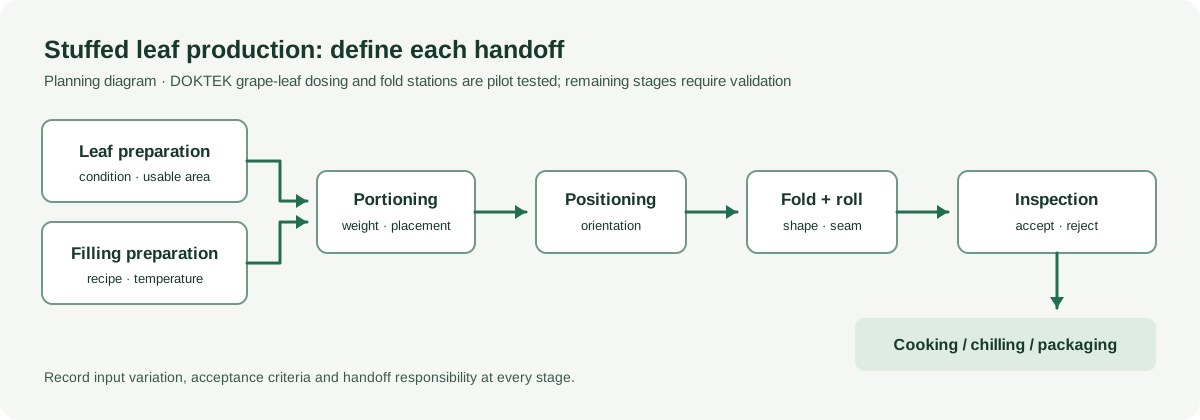
Swipe to inspect the process stages.
What Is Stuffed Leaf Production?
The process combines a prepared edible leaf with a measured filling, closes it to a defined shape, and moves the roll to cooking, chilling, freezing or packing. A line can mix manual and automated stations. The practical design unit is each handoff: what condition the product arrives in, how it is checked, and what the next station can accept.
Grape Leaf Production
Record whether leaves arrive fresh, blanched or brined; size range, orientation, tears, vein thickness, drain time and temperature all affect presentation. A good trial includes difficult leaves from normal batches, not only carefully selected examples. DOKTEK's grape-leaf pilot demonstrates dosing and pre-fold on real leaves. Leaf feeding, complete rolling, forming and discharge still need engineering and validation.
Cabbage Leaf Production
A cabbage leaf needs its own process definition: variety, blanching or fermentation, usable area, rib treatment and moisture after draining. The larger leaf and central rib change the support and fold geometry. A grape-leaf station cannot be assumed to work on cabbage; DOKTEK treats it as a separate engineering application with no validated cabbage rolling cycle.
Leaf Preparation
Draw the boundary between the factory's preparation operation and a proposed rolling station. Specify where leaves are separated, softened, trimmed, drained and rejected. Measure the fraction that can lie flat without tearing. If a person must orient every leaf, include that work in the staffing and capacity model rather than hiding it in an upstream assumption.
Filling Preparation
Give the engineering team the actual recipe at the temperature and moisture it has at the depositor. Particle size, free liquid and ingredient cohesion affect portioning, carryover and cleaning. Rice, bulgur, meat and vegetable fillings may require different tooling or settings. Define changeover and allergen-cleaning needs before selecting a dosing method.
Portioning
Specify target filling weight, acceptable variation, placement on the leaf and the method used to measure it. A sample trial should record underfilled, overfilled and misplaced portions separately. DOKTEK's grape-leaf dosing pilot demonstrates the station principle; a buyer's recipe and target tolerance still require a product-specific test.
Folding and Rolling
Agree the final length, diameter, seam appearance, tightness and whether an open end is acceptable. Check failures after transfer and cooking as well as immediately after folding. DOKTEK has a working grape-leaf fold station, but it has not published a validated complete roll-to-discharge specification. Cabbage fold and roll settings require their own trial.
Inspection
Write acceptance criteria that an operator can apply consistently: intact leaf, contained filling, target weight, closed seam and usable dimensions. Record rejects by cause. A camera may help locate a leaf or inspect visible geometry, but it cannot by itself prove filling weight or cooked-product integrity. Decide which checks need weighing, vision, manual inspection or downstream sampling.
Ready-Meal Integration
Map the actual receiving and discharge points: upstream leaf and filling supply, operator access, reject removal, cooking vessel or conveyor, chilling/freezing and pack presentation. Define who owns each interface and what happens on a stop. Throughput at a rolling station is irrelevant if the downstream tray or cooker cannot accept the product.
Packaging Options
A roll may go to a cooking tray, bulk container, chilled ready-meal pack or frozen-food line. Specify pack count, orientation, sauce addition, sealing and labelling as downstream requirements. Packaging equipment should be evaluated against the finished product's shape and handling tolerance; it is not a verified function of DOKTEK's leaf pilot.
Key Automation Challenges
The biggest unknowns are the real distribution of usable leaves, repeatable presentation, filling behavior during dosing, a fold that does not tear, and a roll that survives discharge. Treat each as a trial question with samples, an acceptance rule and a recorded result. Machine vision is useful only where a detectable feature can drive a defined machine decision.
When Automation Makes Sense
Measure current pieces per operator-hour, staffing by shift, rejected leaves, rework, recipe changes, cleaning time and peak seasonal demand. Compare a partial station with the full-line concept. A pilot should test representative worst-case input and count accepted rolls after the relevant downstream step. No universal capacity or payback figure is justified before that evidence exists.
Questions Buyers Should Ask
Bring a short manual-process video, leaves in production condition, filling samples, a drawing of the line and photos of acceptable and rejected rolls. Ask which stations have been demonstrated on your product, how the sample plan covers normal variation, how acceptance is measured, which interfaces are included, and what evidence is required before a capacity guarantee or factory acceptance test can be agreed.
- Which station is running now, and on which leaf and recipe?
- What are the sample sizes and reject categories for the proposed trial?
- How will a roll be checked after transfer, cooking or packing?
- Who supplies leaf preparation, utilities, sanitation and downstream handling?
- What must be demonstrated before quoting throughput, dimensions or delivery scope?
Next step
Evaluate the process on your product.
The correct automation decision depends on your product, line layout and target process.