Technical article
How Automatic Cabbage Roll Machines Work
A cabbage roll line must turn leaves of uneven size and rib thickness into rolls that match a food plant's recipe and tray specification. This guide separates the process a buyer needs to define from the machinery DOKTEK has actually tested: dosing and fold stations on grape leaves only. Cabbage remains a separate engineering application that requires trials on the buyer's prepared leaves.
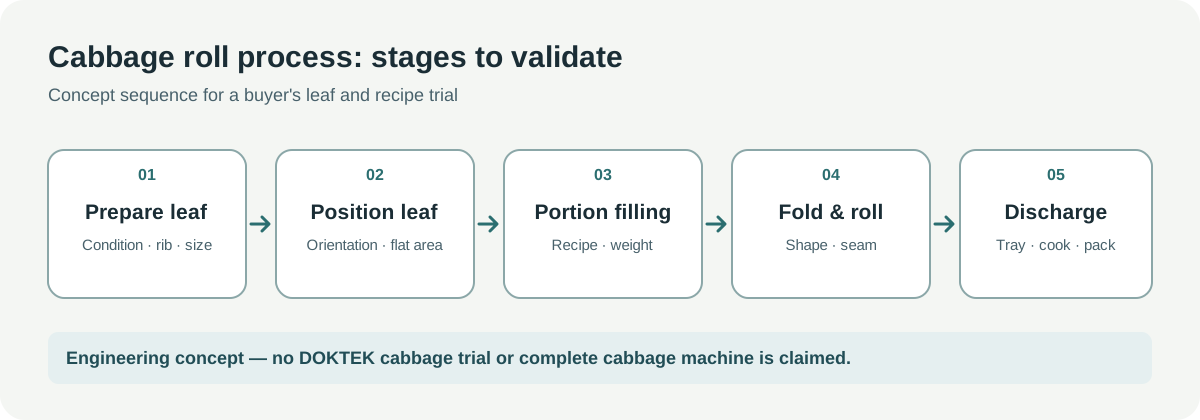
Swipe to inspect the process stages.
Cabbage Leaf Preparation
The plant first defines the leaf it will feed: cabbage variety, leaf size range, whether it is blanched or fermented, and how the central rib is handled. Softening makes a leaf easier to fold, but a wet or damaged leaf can also tear or cling to a conveyor. Preparation has to be documented as an input to a trial, not assumed from a recipe name.
For a sample test, keep leaves in the same condition as at the production station, including drain time and temperature. Record how many are whole, rib-trimmed or unsuitable. That tells the engineer whether manual sorting, a preparation station or a changed specification is needed upstream.
Filling Portioning
The filling must be delivered as a repeatable portion without crushing ingredients or blocking the depositor. Rice, meat, bulgur and vegetable mixtures behave differently as moisture, particle size and temperature change. The buyer should define target portion weight and acceptable variation, then test the actual recipe. DOKTEK has a running dosing pilot on grape leaves; cabbage filling has not been validated.
Leaf Positioning
A leaf needs a known orientation and enough flat area around the filling for a stable fold. Irregular edges, a thick rib and variable curvature change the available folding area. Camera-based detection or guided placement may be evaluated, but neither is a verified cabbage feature of DOKTEK's pilot line.
Folding, Rolling and Product Discharge
The intended sequence is to contain the filling with side folds, roll the leaf to the buyer's length and diameter, then hand the roll to a tray or conveyor without it opening. Fold force, roll pressure and the point of release must be determined on prepared leaves and a real filling. A complete cabbage fold-to-discharge cycle has not been demonstrated by DOKTEK.
The discharge specification matters early: a roll for batch cooking may need different orientation and spacing from one headed to a freezer or tray sealer. Tray loading and packaging are line interfaces to scope, not included functions of the current pilot.
What Makes Cabbage More Difficult Than Grape Leaves?
A prepared cabbage leaf is generally larger and has a stronger central rib than a grape leaf. Its usable area and flexibility vary across the head and with preparation. The fold geometry, support surface and portion position therefore need their own trials; transferring settings from a grape-leaf station would not validate a cabbage roll.
Industrial Applications and Line Integration
Ready-meal, frozen-food and central-kitchen operations can evaluate a cabbage rolling station between leaf and filling preparation upstream and cooking, freezing or packing downstream. A line review should map handoffs, food-contact cleaning requirements, available floor space and who removes rejected leaves. No universal line layout or throughput is implied here.
When Automation Makes Sense
Measure the present process before asking for a machine quote: pieces per operator-hour, leaf rejection, rework, product sizes, number of recipes and peak-shift demand. Send representative leaves and filling, plus a short video of the manual fold. A trial can then establish which station is technically feasible and what still requires development.
Next step
Evaluate the process on your product.
The correct automation decision depends on your product, line layout and target process.